
How Do We Count Pollen?

1001 Noble Street
Fairbanks, Alaska 99701
Phone (907)459-3500
Toll Free (888)459-3500
Fax (907)459-3583

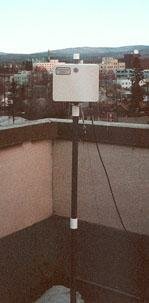
There are several methods used to collect pollen and fungal spores from our atmosphere. Here at the Tanana Valley Clinic, we use a Rotorod which is manufactured by Sampling Technologies, Inc. and is used widely for counting pollen throughout the United States. Our Rotorod is on the northwest corner of the Tanana Clinic building and we have provided a second Rotorod to the University of Alaska-Fairbanks.
The Rotorod is comprised of two silicone covered, greasy rods which are attached to a motor and timer. One minute out of every 10 the motor turns a small metal case hanging below the machine. The centrifical force of its turning causes the two sticky rods to snap out of their cases and to be exposed to the atmosphere. They spin rapidly, at 2500 revolutions per minute; pollen and fungal spores become projectiles as they drift by and become deeply embedded in the silicone surface of the rods. The spinning action of the small plastic rods corrects for wind bringing excessive amounts of pollen onto the rods, which would cause an inaccurately high pollen count. After each cycling period, roughly 24-48 hours, the rods are removed and placed in a plastic slotted holder. They are stained with a solution that illuminates pollen granules with a pink color and mold spores with a brown color. The rods are examined under the microscope and the number of pollen granules and mold spores are counted and identified. Identity of these objects can be complex and requires knowledge of their size, shape, color and texture. A mathematical formula is used to figure the number of pollen and mold spores per cubic millimeter. These numbers are used to determine the pollen and mold spore count, either low, medium, high or very high. On this web site we attempted to correlate the level of pollen and mold spores to the severity of symptoms allergy suffers may experience depending on their individual sensitivity.
Pollen counts fluctuate widely from day to day but tend to be highest on warm, dry, breezy days and lowest during chilly or wet periods. In general, alder is the first pollen seen, just after breakup. Another highly allergic pollen is birch, which peaks in the second week of May and is highly variable in its numbers. At its highest, it can increase to 3000 pollen granules per cubic millimeter in a matter of three to four days. Many allergy suffers complain of symptoms "at the coming and the falling of the leaf." The springtime occurrence of their symptoms is easy to correlate with birch and alder pollens. The fall time reaction is less clear cut. Many people implicate fireweed, although fireweed historically has never been allergenically active and many patients I have tested had no reaction. Alternaria mold spores are a prime suspect as are other mold spores. The Rotorod was working last fall to try to catch this bloom of mold spore. Over two to three weeks nothing was found but this will be pursued next fall.
J. Timothy Foote, M.D.
Susan Harry, MT (AMT)